Your child knows cat and dog. They can sound out mud. But said stops them cold, and was keeps coming out as saw. If that sounds familiar, you have met the sight-word wall.
Flashcards have their place. But there is an older, gentler idea with decades of research behind it: let your child hear the words while their eyes are on them. Researchers call it reading while listening, or assisted reading. Here is what the evidence does and doesn't show, and a short routine to try at home.
What sight words are, and why they are tricky
Sight words are the small, common words that turn up in almost every sentence: the, and, said, was, of, could. In 1936, Edward Dolch published a basic sight vocabulary of 220 words. He built it from the words common to three leading word lists of his day. He called them "tool" words, because they are used in all writing, whatever the subject. He left nouns out on purpose, since nouns change with the topic. His list is now usually split into levels from pre-primer to third grade. Another well-known list comes from Edward Fry, who updated his Instant Word List in 1980 using newer counts of how often words appear in print.
Two things make these words harder than they look. Many are abstract. There is no picture for of or could. And many have spellings a beginner can't fully sound out yet, like said, one or come.
A sight word is more than a memorized shape
Researchers use the term more broadly than schools do. For reading researcher Linnea Ehri, a sight word is any word a reader recognizes instantly from memory. Her 2014 review describes how words get there, through orthographic mapping. The reader connects the letters in a word to its sounds, and those connections bind the spelling, pronunciation and meaning together in memory. With practice, every word ends up being read this way, not just the common or irregular ones.
That mapping depends on knowing how letters and sounds work. So sight words are not memorized like photographs. Phonics is part of how they stick.
Why instant recognition matters
In 1974, David LaBerge and S. Jay Samuels proposed that a skill needs our attention while we are still learning it, and stops needing it once it is automatic. Ehri makes a similar point: when a child knows a word on sight, its sound and meaning come to mind at once, leaving attention free for the story. A child who has to work out was in every sentence has little left for meaning. That is why fluency, which the National Reading Panel described as reading with speed, accuracy and proper expression, matters so much.
What is reading while listening?
A fluent reader, live or recorded, reads a text aloud while the child follows the same words on the page.
Taped books in the 1970s
In a 1976 article called "After Decoding: What?", Carol Chomsky described working with children who had been taught phonics but still could not read fluently. They listened to tape-recorded books again and again while following the printed text, until they could read the books on their own. At first, keeping their eyes in step with the voice on the tape was hard. With familiarity it got easier. Her report was encouraging, and fluency reviews still cite it.
Reading in unison
Earlier, in 1969, R. G. Heckelman described what he called the neurological impress method. An adult sits just behind the child. They hold one book and read aloud together while the child slides a finger along each line. The adult doesn't stop to teach sounds or ask questions. Studies of this exact method have had mixed results. But the core idea is the same: eyes, ears and voice on the same words at the same moment.
What the bigger reviews found
In 2000, the National Reading Panel reviewed experimental studies of guided oral reading, a family of methods that includes repeated reading, reading with a partner, reading in unison and reading along with a recording. As a group, these methods had a consistent, positive effect on word recognition, fluency and comprehension across a range of grades. The overall effect was moderate.
A 2003 review by Melanie Kuhn and Steven Stahl found that assisted approaches, where a child reads with support from a fluent model, seemed to work better than unassisted ones. Rereading the same text did not show a clear edge over reading a variety of texts.
Audiobooks fit here too. In a 2011 study, upper elementary students with reading disabilities did assisted reading with digital audiobooks four or five times a week for eight weeks. Their fluency grew far more than that of classmates who did silent reading, though attitudes toward reading did not differ.
Why seeing a word while hearing it may help
Ehri's lab has tested this with new vocabulary. In a 2008 study, second and fifth graders learned unfamiliar nouns and saw the spellings of only some of them while studying. They remembered the pronunciations and meanings of those words better, even though the spellings were gone at test time. Nobody asked them to study the letters. The researcher simply said each word as it appeared, and the children repeated it.
A follow-up study found that when fifth graders said new words out loud while reading a passage silently, they remembered the words and their spellings better than classmates who read them silently. The weaker readers gained the most.
These studies taught new vocabulary, not sight words to beginners. But they point to the same idea: when spelling, sound and meaning arrive together, they tend to stay together.
Evidence from language learners
In a 2008 study of Japanese university students learning English, reading while listening and reading alone led to similar vocabulary gains, and listening alone to far fewer. Words that came up more often in the story were more likely to be learned. Most students preferred reading while listening, partly because the narrator chunked the text for them. Still, most new words were not learned in any mode.
A 2023 meta-analysis of 30 studies found a small overall comprehension benefit for reading while listening over reading alone. It showed up mainly when the reading pace was set for the reader. When readers went at their own pace, reading alone did about as well. The author saw possible benefits for struggling readers and second-language vocabulary, but said there are too few studies to be sure.
What the research does not show
Read-along audio will not teach your child to read on its own. The evidence supports something more modest.
- Listening alone does not teach decoding. The National Reading Panel found that systematic phonics instruction helped children learn to read more than unsystematic or no phonics, with the biggest impact when it starts in kindergarten or first grade. A 2018 review by Anne Castles, Kathleen Rastle and Kate Nation explains why phonics is so central to reading English. Read-along practice is a partner to phonics, not a replacement. Even Dolch said a child who was weak at sounding out words should get training in that skill.
- The eyes have to be on the words. In an eye-tracking study of 44 preschoolers, only about 5 to 6 percent of children's eye fixations landed on the print when an adult simply read the book. When the adult pointed to and tracked the words, or talked about them, attention to print rose significantly. Fluency researchers say the same about taped books: children who listen without following the print won't build fluency.
- Highlighting is a pointer, not a teacher. In a French study, 40 children in grades 3 to 5 read stories with each word lighting up karaoke-style as it was spoken. The highlighting drew their eyes to the current word, but it didn't help them remember the spelling of new made-up words, and it made their memory for those words' meanings worse. Most preferred plain text, though the weakest readers leaned toward the highlighting. Use highlighting to guide the eyes, then stop and talk about the words.
- Much of this research involved older readers. Many studies looked at children who could already decode, older students or adults, so they say less about brand-new readers. Treat reading while listening as one good tool among several.
How to practice sight words at home: a 10 to 15 minute routine
This routine borrows from the research above. It works with any audio that has matching text: an audiobook with the printed book, a read-along e-book or an app.
- Pick a topic your child loves. Volcanoes, sharks, trains. Interest makes a second listen an easy sell.
- Listen once just for fun. No stopping, no quizzing. Let your child enjoy it.
- Listen again with eyes on the words. Sit side by side and run a finger under each line, or let your child do it. Slow the audio if you can.
- Pause on a sight word. When one of this week's words comes up, pause. Ask your child to point to it and say it out loud.
- Play "spot the word." Pick one word, like said, and hunt for every said on the page. Then look for it on a cereal box or in a picture book.
- Read a line together. Read one sentence aloud in unison, then let your child try it alone.
- Move a word when it's ready. When your child reads a word instantly in a few different places, move it from "this week" to "already know." Add a new one.
- Keep phonics going. Spend a minute sounding out a regular word from the story, or talk about which part of a tricky word like said doesn't sound the way it looks.
- Stop while it's still fun. Keep it short and happy.
Adjusting for your child's stage
If your child isn't reading yet, keep it light. You do the pointing, so they see that the words on the page are the words in their ears. Spot one or two words, like I or the, together, and keep playing with letters and sounds.
If your child is starting to sound out words, let them follow along and say the sight words when they come up. Choose short pieces so you can hear the same one twice.
If your child can decode but reads word by word, this is where fluency researchers say reading while listening fits best. Listen to the same short passage a few times, then have your child read it aloud without the audio. That is close to what Chomsky's children did.
How HootPODS fits in
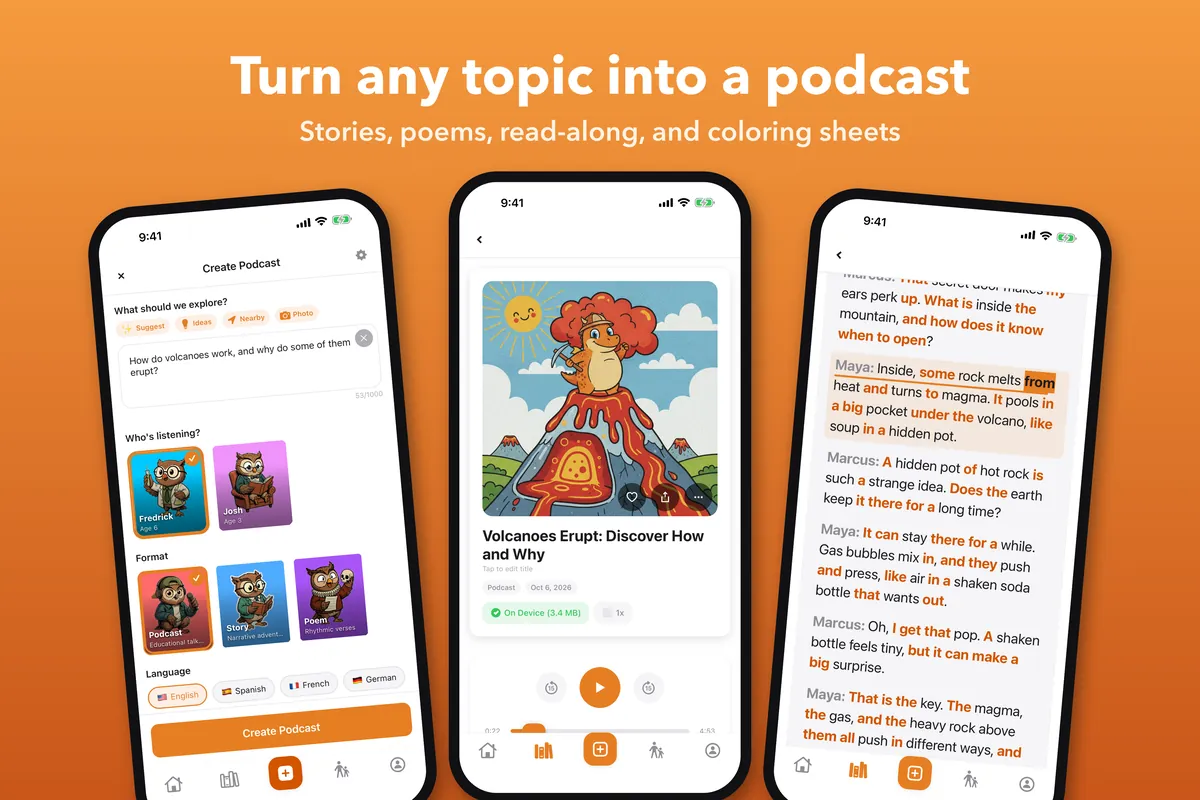
HootPODS is an iPhone app that turns any topic into a short audio episode for your family. A few of its features line up with the routine above.
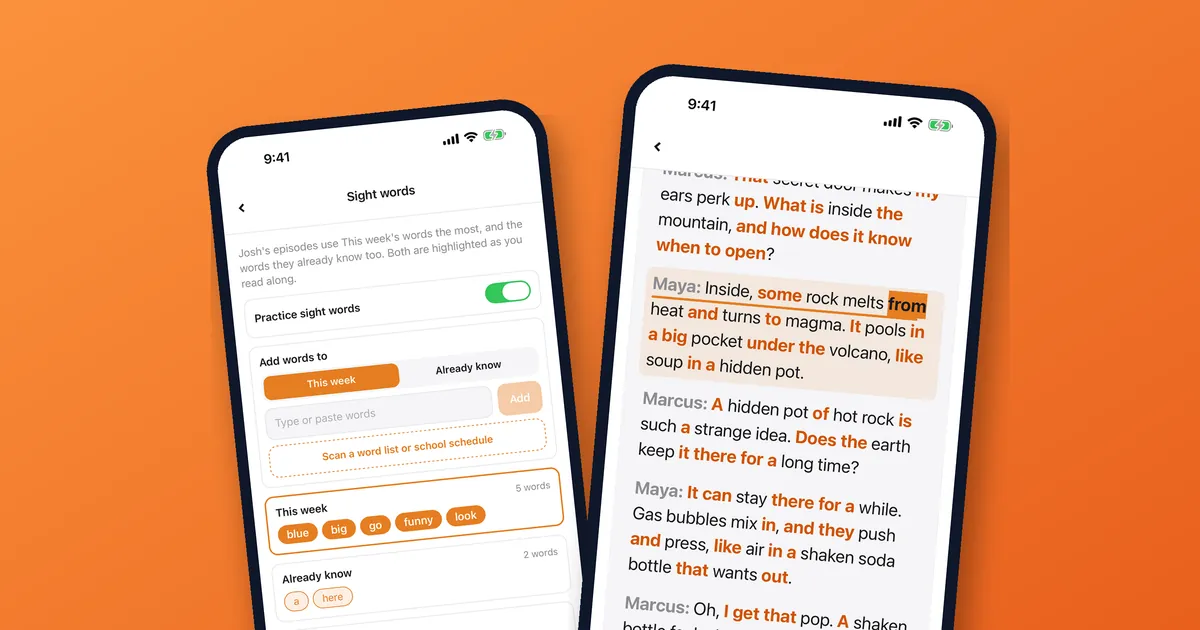
- Sight words for each child. In a child's profile, pick words from the Dolch lists (pre-primer through grade 3), type or paste your own, or scan the list your child's school sent home with the camera or from Photos. The scan is read on your iPhone.
- This week and Already know. Each word sits in one of the two groups. Episodes use this week's words the most and keep known words in the mix.
- Read-along transcript. On episodes made with sight words turned on, the transcript follows the audio line by line and highlights the sight words as they are spoken.
- Short episodes and adjustable speed. Episodes can be as short as 1 minute, and playback runs from 0.5× to 2×, so you can slow things down for following along.
- The For the grown-ups card. It lists 1 to 3 new words from the episode and two dinner-table questions to keep the conversation going.
See it in the read-along section of our home page.
Common questions
How many sight words should my child work on at once?
There is no research-backed magic number. Repetition matters, though: in the language-learner study above, words that came up more often were more likely to be learned. If your child's school sends home a weekly list, start there.
Do audiobooks count as reading?
Listening to stories is valuable in its own right. But for building word reading, your child's eyes need to be on the text. Listening alone does not teach decoding.
Should we still use flashcards?
They can help. Dolch himself suggested flashing the words on small cards until a child knew them instantly. But fluency researchers stress practice with connected text, not only words in isolation. A quick card game plus a read-along gives your child both.
My child memorizes the story instead of reading it. Is that a problem?
Not at first. Chomsky's approach openly used memory as a bridge into reading. Just check that the words travel. Point to a sight word out of order, or find it in a different book. If your child can read it there, it's theirs.
Sources
- Brown, R., Waring, R., & Donkaewbua, S. (2008). Incidental vocabulary acquisition from reading, reading-while-listening, and listening to stories. Reading in a Foreign Language, 20(2), 136–163. nflrc.hawaii.edu/rfl/item/174
- Castles, A., Rastle, K., & Nation, K. (2018). Ending the reading wars: Reading acquisition from novice to expert. Psychological Science in the Public Interest, 19(1), 5–51. doi.org/10.1177/1529100618772271
- Chomsky, C. (1976). After decoding: What? Language Arts, 53(3), 288–296, 314. ERIC EJ141119
- Clinton-Lisell, V. (2023). Does reading while listening to text improve comprehension compared to reading only? A systematic review and meta-analysis. Educational Research: Theory and Practice, 34(3), 133–155. ERIC EJ1403866
- Dolch, E. W. (1936). A basic sight vocabulary. The Elementary School Journal, 36(6), 456–460. jstor.org/stable/995914
- Ehri, L. C. (2014). Orthographic mapping in the acquisition of sight word reading, spelling memory, and vocabulary learning. Scientific Studies of Reading, 18(1), 5–21. doi.org/10.1080/10888438.2013.819356
- Esteves, K. J., & Whitten, E. (2011). Assisted reading with digital audiobooks for students with reading disabilities. Reading Horizons, 51(1), 21–40. scholarworks.wmich.edu
- Fry, E. (1980). The new instant word list. The Reading Teacher, 34(3), 284–289. ERIC EJ236457
- Gerbier, E., Bailly, G., & Bosse, M.-L. (2018). Audio-visual synchronization in reading while listening to texts: Effects on visual behavior and verbal learning. Computer Speech & Language, 47, 74–92. doi.org/10.1016/j.csl.2017.07.003
- Heckelman, R. G. (1969). A neurological-impress method of remedial-reading instruction. Academic Therapy Quarterly, 4(4), 277–282. ERIC EJ007103
- Justice, L. M., Pullen, P. C., & Pence, K. (2008). Influence of verbal and nonverbal references to print on preschoolers' visual attention to print during storybook reading. Developmental Psychology, 44(3), 855–866. doi.org/10.1037/0012-1649.44.3.855
- Kuhn, M., & Schwanenflugel, P. (2006). All oral reading practice is not equal or how can I integrate fluency into my classroom? Literacy Teaching and Learning, 11(1), 1–20. ERIC EJ903239
- Kuhn, M. R., & Stahl, S. A. (2003). Fluency: A review of developmental and remedial practices. Journal of Educational Psychology, 95(1), 3–21. doi.org/10.1037/0022-0663.95.1.3
- LaBerge, D., & Samuels, S. J. (1974). Toward a theory of automatic information processing in reading. Cognitive Psychology, 6(2), 293–323. doi.org/10.1016/0010-0285(74)90015-2
- National Institute of Child Health and Human Development. (2000). Report of the National Reading Panel. Teaching children to read: An evidence-based assessment of the scientific research literature on reading and its implications for reading instruction. Reports of the subgroups (NIH Publication No. 00-4754). nichd.nih.gov
- Partridge, S. (1979). The neurological-impress method of teaching reading. ERIC document. ERIC ED186843
- Rosenthal, J., & Ehri, L. C. (2008). The mnemonic value of orthography for vocabulary learning. Journal of Educational Psychology, 100(1), 175–191. doi.org/10.1037/0022-0663.100.1.175
- Rosenthal, J., & Ehri, L. C. (2011). Pronouncing new words aloud during the silent reading of text enhances fifth graders' memory for vocabulary words and their spellings. Reading and Writing, 24(8), 921–950. doi.org/10.1007/s11145-010-9239-x