Skip to content

A parents' guide to HootPODS

Short audio episodes fit into the in-between parts of family life: the drive to school, the wind-down before bed, the "why?" at dinner. Here is how to use HootPODS well, from your bedtime routine to sight words practice at home.

Where short episodes fit in your day

Audio learning asks for ears, not eyes. HootPODS keeps playing in the background and on the lock screen, so the iPhone can sit face down while your child listens, builds, colors or drifts off. That makes it an easy source of screen-free audio for the parts of the day that already have a gap in them.

A calmer bedtime routine

Give the episode the same slot every night, after teeth and before lights out. A story with one narrator and a gentle tone suits the end of the day better than a lively two-host podcast. Save "spooky but safe" for the afternoon. There is no auto-play, so when the episode ends, the room goes quiet.

Car rides and travel

Episodes are saved on your iPhone, so they play on a plane or a long drive with no signal. Make a few at home before you leave. Play them over Bluetooth or AirPlay. There is no CarPlay app, so start playback from the phone.

Quiet time

Pair an episode with something for the hands. Print the coloring page from the story and let your child color the scene while they listen. Ten or 12 minutes covers a good stretch of rest, and a favorite from the library can play again.

Answering "why?"

When a question stumps you at dinner, type it in exactly as your child asked it. Their own words keep the focus on what they wanted to know. Listen together, then ask what surprised them.

School topics and homeschool

Ask what the class is studying this week and make an episode about it. A podcast explains, a story wraps the same facts in a plot, and a poem helps with lists to remember, like the planets. Set the reading level to match.

A second language

Episodes can be in 15 languages. If your child is learning Spanish or French, make an episode in that language about a topic they already know well. The ideas are familiar, so the new words have room to land.

Pick a length by attention span

HootPODS offers 1, 3, 5, 7, 10 and 12 minutes. There is no right length for an age. There is only the listener in front of you. Some starting points:

  • 1 minute: a quick answer to one question, or a first try at a new topic.
  • 3 minutes: breakfast, a short drive, the walk to school.
  • 5 to 7 minutes: a bedtime story or the school run.
  • 10 to 12 minutes: quiet time, a long drive, or a listener who always asks for more.

Watch your child, not the clock. If attention drifts before the end, go shorter next time. If they ask for another, go longer. Premium voices go up to 7 minutes, so choose standard voices for 10 or 12.

Read along with your child: a sight words routine

If your child is learning to read, sight words practice at home can happen inside a story they already want to hear. Turn on sight words in their profile, and their episodes come with a read-along transcript. It follows the audio line by line and highlights the sight words as they are spoken.

  1. Set up the words

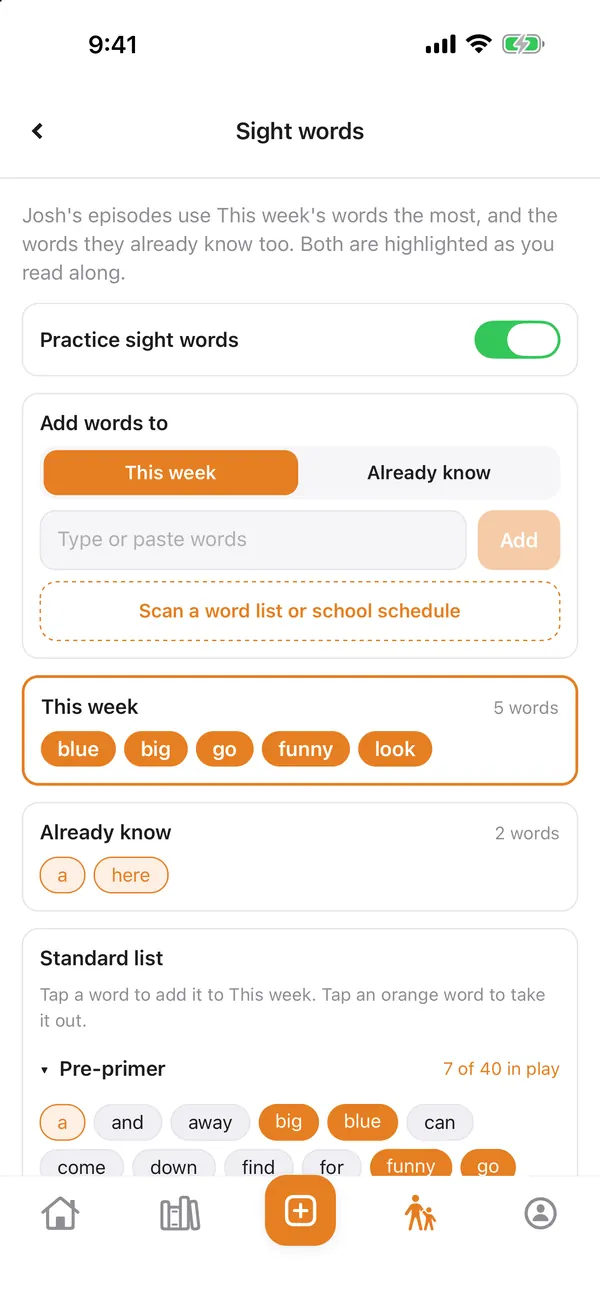
    In your child's profile, start from a Dolch list (pre-primer, primer, grade 1, grade 2 or grade 3). Or type or paste the words. Or scan the list that came home from school, with the camera or from Photos. The scan is read on your iPhone.

  2. Choose this week's words

    Put a small handful in This week. Three to five is plenty to start. Words your child already reads with ease go in Already know.

  3. Make an episode they will love

    Pick their profile and a topic from their interests. Keep it short: 3 or 5 minutes is enough for practice. Episodes use this week's words the most.

  4. Listen first

    Play it once just for the story. No reading, no pointing. Let them enjoy it.

  5. Then read along

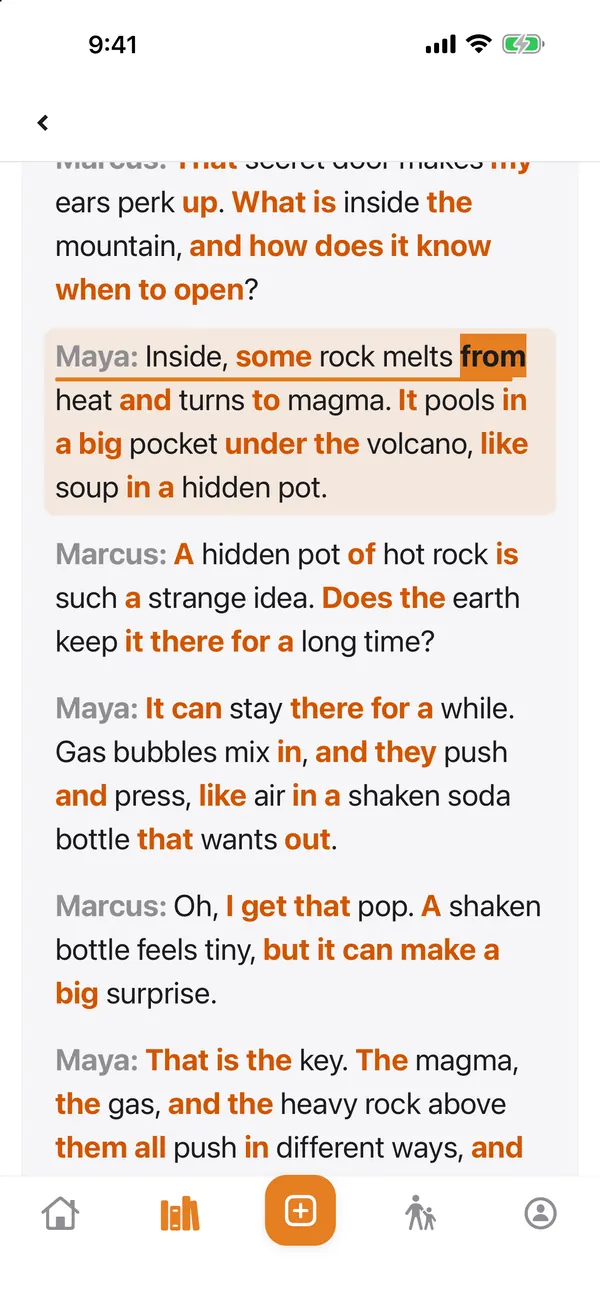
    Play it again with the read-along transcript open. Sit close and point at each highlighted word as it is spoken. Invite your child to say it with the narrator. If the words go by too fast, slow the playback speed down.

  6. Move words along

    When a word is easy every time, move it to Already know and add a new one to This week. Known words stay in the mix, so they keep getting reviewed without extra drills.

A read-along transcript of a volcano episode, the sight words highlighted in orange
The sight words screen, with this week's words and a standard word list

Use the For the grown-ups card

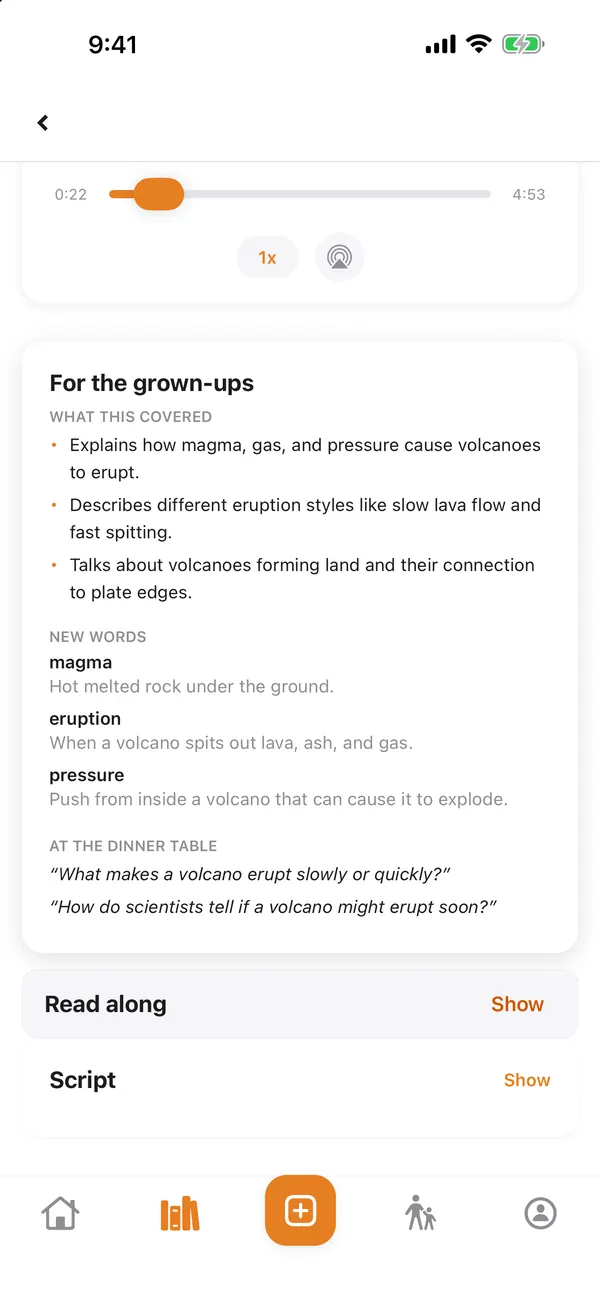
Below the player, every episode has a short card for you. It lists what the episode covered, 1 to 3 new words, two dinner-table questions, and 1 or 2 book suggestions. A few ways to use it:

  • Skim it while the episode plays, so you know what your child just heard.
  • Use the new words during the day. "Magma" at dinner, "pressure" while pumping up a bike tire.
  • Ask the dinner-table questions, and answer them too. Children often enjoy hearing a grown-up guess.
  • Follow the thread. If a question sparks a debate, make the next episode about it. Volcanoes, then earthquakes, then how mountains form.

The book suggestions come from our sister site, HootRated, which gives children's books age ratings and content guides. They link to Amazon or Audible, and we may earn a commission if you buy.

The For the grown-ups card for a volcano episode: what it covered, three new words and two dinner-table questions

Choosing topics and story tone

Start with what your child already loves. Add their interests to their profile, and episodes are written with those in mind. When you run out of ideas, Explore Ideas has 30 categories in 6 groups, from space and animals to myths and holidays. Surprise Me is perfect for the listener who says "anything!"

Then pick the format. A podcast explains, a story imagines, and a poem keeps things short and rhythmic. Stories come with extra controls: character, setting, tone, conflict and theme. A few ideas:

  • Character: make a favorite stuffed animal the hero.
  • Setting: set the story somewhere you are about to go, like the dentist or a new school, so the place feels familiar first.
  • Conflict: choose a gentle one for bedtime and a bigger one for daytime listening.
  • Theme: use it to talk about something real, like sharing, being brave or a new baby in the family.
  • Tone: "spooky but safe" suits a child who likes a little shiver, best in daylight.

Finally, the reading level: K–2, 3–5, 6–8 or 9–12. Pick the one that matches how your child listens and reads, not only their grade at school.
Privacy and safety controls

You decide what HootPODS knows about your family, and you can change your mind. Here is what is in your hands. Read the privacy policy

What goes in a profile

A profile can hold a first name, age, interests, language and sight words. Profiles are optional. You can skip them and make every episode for a general audience instead.

AI consent

Episodes are written, narrated and illustrated by AI services from OpenAI, ElevenLabs and Google. Before your first episode, the app shows exactly what it sends and asks for your OK and your date of birth. Withdraw consent in Profile.

A parent check

A quick multiplication question comes before sharing, printing or saving coloring pages, and before links that leave the app. If you would rather not use it, turn it off in Profile.

Photos and places

A photo you use for an idea is sent to OpenAI to analyze it. Nearby places does not send your location to HootPODS. A scanned word list is read on your iPhone.

No ads

There are no ads in HootPODS, and no ad or analytics code. The app uses crash reporting only.

Deleting your account

Go to Profile, then Delete Account. You get a 30-day grace period in case you change your mind, or you can choose Delete now.

Where to go next

New to the app? How HootPODS works walks through every step, from picking a topic to printing the coloring page. Questions about credits, devices or accounts are on the FAQ. For more ideas, browse the blog or listen to a free episode of HootPODS Originals.

Questions

What length should I choose for my child?

Start with what they can enjoy all the way through. One or 3 minutes is a good first try. Bedtime stories often fit in 5 to 7 minutes, and 10 or 12 minutes suits quiet time and long drives. If they drift, go shorter next time.

Should I listen with my child?

At least at first. Episodes are written by AI, so listening first or together is a good habit, especially for new topics. It also gives you something to talk about afterwards, and the For the grown-ups card has two questions ready.

How do I practice sight words at home with HootPODS?

Turn on sight words in your child's profile, choose a few words for This week, and make a short episode on a topic they love. Listen once for the story, then play it again with the read-along transcript and point at each highlighted word. Move words to Already know as they get easy.

How often should my child listen?

There is no set amount. A single short episode at a regular time, like bedtime or the drive to school, is an easy habit to start. Stop when your child stops asking for more.

What if a story is too scary for my child?

Pick a gentle conflict and tone, and save "spooky but safe" for daytime. Listen together the first few times so you can pause and talk. You can delete any episode from the library, and we would like to hear about it at support@hootpods.com.

What if an episode gets a fact wrong?

It can happen, because episodes are written by AI. Turn it into a small lesson: look it up together and talk about how you checked. Please also tell us at support@hootpods.com.

Make your first episode tonight.

Free to download, with 200 free credits to start. iPhone, iOS 18.6 or later.

Download on the App Store