It's 8:47 AM and you're three minutes from the bell. You've got your guided reading groups planned, your phonics stations ready, and your "independent reading" bin stocked with leveled books. You know exactly what's going to happen: Group A will finish their assignment in six minutes and get loud. Group B will need you to re-explain the directions three times. Your English learners will smile and nod but disengage. And that brilliant kid who reads at a seventh-grade level? He'll coast through another "free choice" book, bored out of his mind.
Or maybe your classroom is a kitchen table. You homeschool three kids at three different levels, and this week's unit on volcanoes has to work for all of them.
Either way, you're doing everything right. You're differentiating. You're planning. You're paying attention to every learner.
And you're still drowning.
Because here's what no one tells you in professional development: the problem isn't your pedagogy. The problem is that differentiation at scale is incredibly hard with the tools we've been given.
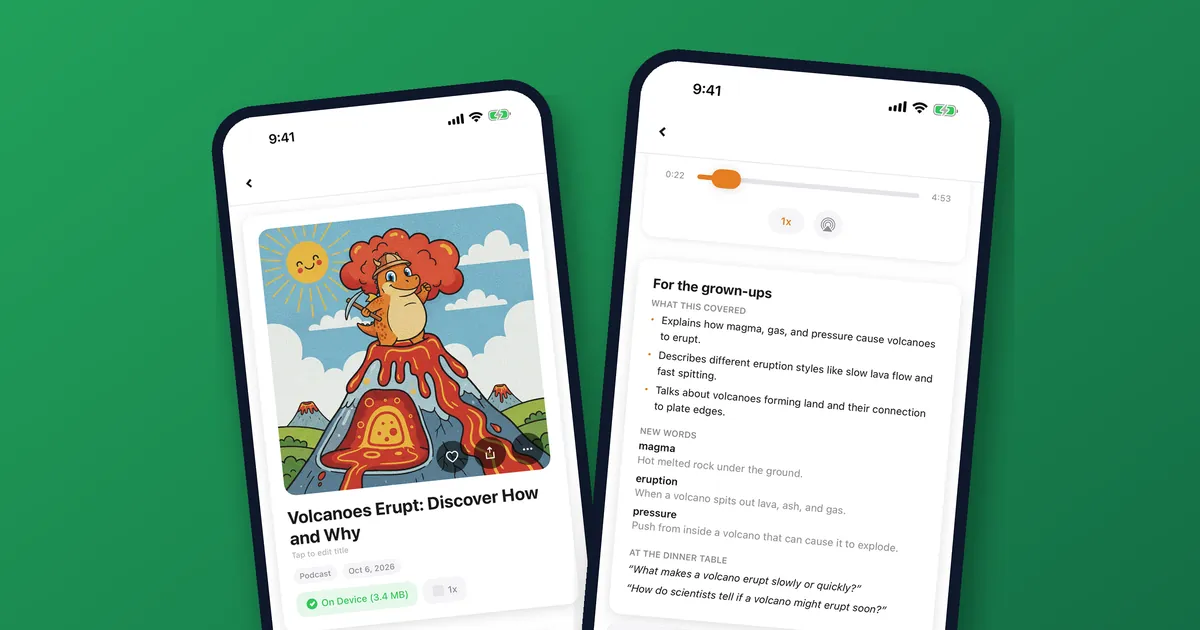
This post is about one small tool that can help: the HootPODS iPhone app, which turns any topic into a short audio episode (a podcast, a story or a poem) in about a minute. It won't run your literacy block for you. But it can give you a fresh piece of audio on exactly what you're teaching this week, pitched at the right level, with discussion questions attached.
Why Listening Belongs in Your Literacy Block
The cognitive science here is solid. The "Simple View of Reading" tells us that reading comprehension is the product of decoding and linguistic comprehension. For elementary students, linguistic comprehension (listening) consistently outpaces decoding, and research shows listening comprehension is typically 2-4 years higher than decoding ability. When we only expose students to texts at their reading level, we're artificially capping their vocabulary growth and background knowledge while we wait for their decoding to catch up.
Audio removes that artificial ceiling. The second-grader who struggles with three-letter words can still follow a story about ancient Rome with vocabulary like "gladiator," "amphitheater," and "empire." Students can engage with the complex ideas, sophisticated vocabulary, and narrative structures their brains are ready for, without being limited by their current decoding ability. They're building the linguistic comprehension foundation that will make them strong readers once their decoding automatizes.
And because it's audio, you're not adding to the visual overload. Students have to actively visualize, infer, and track a narrative: the exact cognitive work that proficient reading requires.
What HootPODS Is (and What It Isn't)
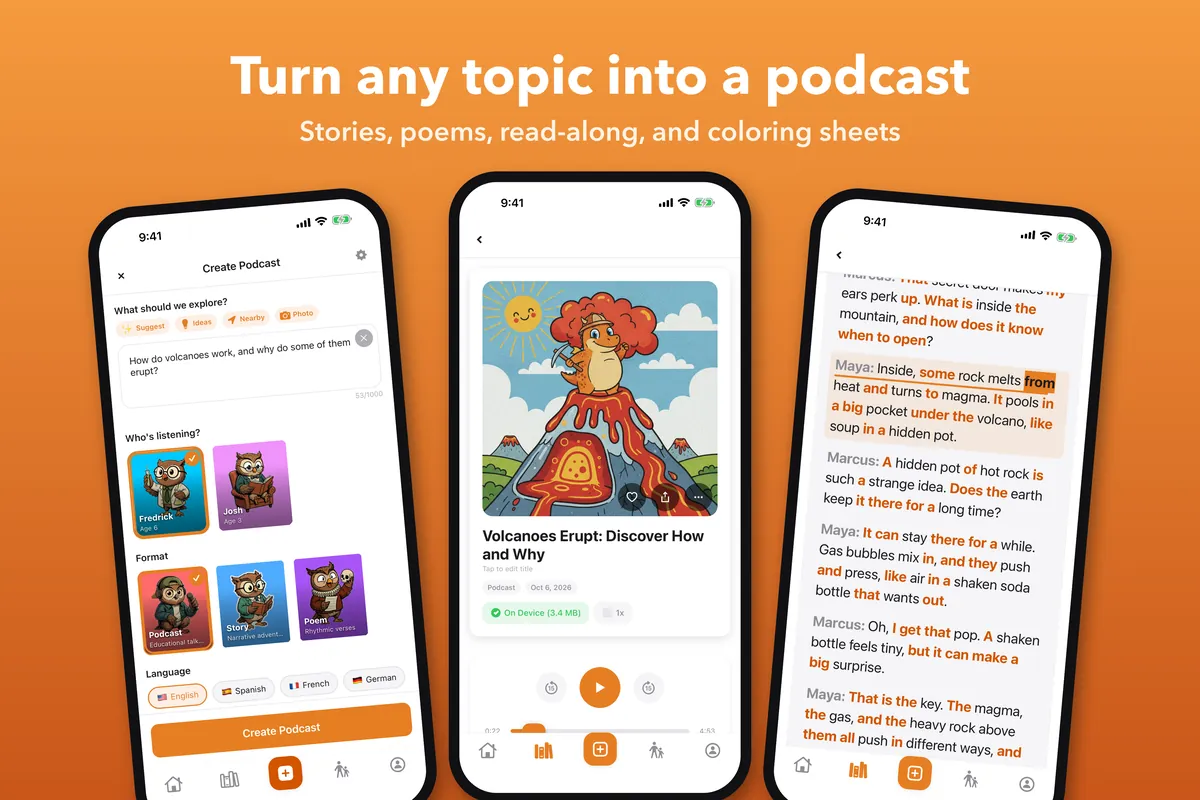
HootPODS is an iPhone app for families. You type a question or a topic, choose a format (podcast, story or poem) and a length (1, 3, 5, 7, 10 or 12 minutes), and the app writes and narrates the episode, with two hosts in conversation or a single narrator. It takes about a minute, and you can start listening while it's still being made.
It is not a classroom platform. There are no student logins, class rosters or dashboards. You make episodes on your own iPhone and play them for your class or your kids. For a lot of teachers and homeschooling parents, that's the appeal: nothing to set up and nothing for students to log into.
Ways to Use It This Week
Preview or review this week's unit
Type the question you want students thinking about: "How do volcanoes form?" "Why did the colonists dump tea in Boston Harbor?" "What happens to a raindrop after it falls?" Or paste a link to an article you're teaching from. Play a 3- or 5-minute podcast at morning meeting to build background knowledge before the lesson, or a story at the end of the week as review.
Short on ideas? Explore Ideas has 30 categories, from space and animals to myths and holidays, and Surprise Me picks a topic for you.
Pitch it at the right level
Choose a reading level for the episode: K–2, 3–5, 6–8 or 9–12. Make two versions of the same topic for two reading groups, or one for your fourth-grader and one for your seventh-grader at the kitchen table.
For stories, you can also set the character, setting, tone, conflict and theme. Doing a unit on courage or kindness? Set the theme and get a story built around it.
Homeschooling? Add a profile for each of your kids, with their first name, age, interests and language. Profiles are optional and unlimited on every plan. In a classroom, choose a general audience instead of making profiles for individual students.
Practice sight words with early readers
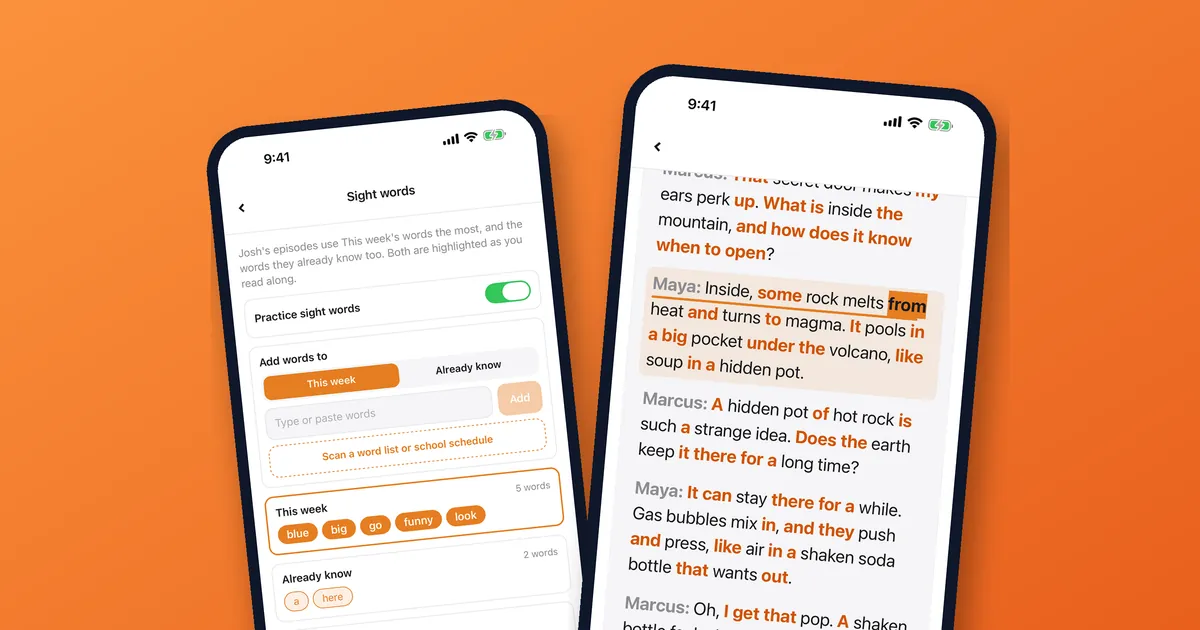
HootPODS can weave sight words into episodes. Start from the Dolch lists (pre-primer, primer, grade 1, grade 2 and grade 3), type or paste your own words, or scan the school's word list with the iPhone camera or from Photos. Words sit in "This week" or "Already know." Episodes use this week's words the most and keep known words in the mix.
When sight words are on, the episode becomes a read-along: the transcript follows the audio line by line and highlights each sight word as it's spoken. Because it's on a phone screen, it works best with one or two children looking on, which makes it a good fit for a homeschool lesson or a small reading group.
Use the For the grown-ups card as a discussion guide
Each episode comes with a For the grown-ups card: what the episode covered, one to three new words, two dinner-table questions, and one or two book suggestions from HootRated, our sister site for children's book ratings. In class, that's a ready-made discussion guide. Put the new words on your vocabulary wall, use the two questions for a turn-and-talk, and add the book suggestions to your library list.
Hand out a coloring page for listening time
Each episode can have a black-and-white coloring page to go with it (you can redraw it up to two times). Print it before you press play and let students color while they listen. Busy hands, open ears. You can also save it to Photos or AirDrop it.
A quick note: before printing, sharing, saving a coloring page or following a link out of the app, HootPODS asks a multiplication question as a parent check. You can turn it off in Profile.
Support English learners and their families
Your English learners need massive amounts of comprehensible oral language input, and you can't provide individualized oral language instruction to every student every day. Short, interesting audio on the topic you're already teaching helps. Playback runs from 0.5× to 2× speed, so you can slow an episode down for newer English speakers.
Episodes can also be made in 15 languages: English, Spanish, French, German, Italian, Portuguese, Dutch, Polish, Russian, Japanese, Korean, Chinese, Arabic, Hindi and Turkish. Make this week's science episode in English for class, then make one in a student's home language and share the link with their family by Messages or WhatsApp, so the conversation can continue at home.
Get ready for a field trip
Before the trip, make an episode on what you're going to see and play it on the bus. At the museum, zoo, aquarium, park or historic site, Nearby suggests episode ideas for the places around you, and your location is not sent to HootPODS. Snap a photo of an exhibit and HootPODS suggests three to five questions about it.
Play it for the whole room
Episodes are saved on your iPhone, so they play offline when the school Wi-Fi drops. Send the audio to a classroom speaker over AirPlay or Bluetooth. Playback keeps going with the phone locked, so you can set it on your desk and walk the room.
Addressing the "Yeah, But..." Thoughts You're Having
"My students are already on screens too much."
You're right to be concerned about screen time. But here, the only screen is your phone, on your desk. Students aren't staring at anything. They're listening with their eyes closed or a coloring page in front of them. The cognitive load is auditory and imaginative, not visual and reactive. This is fundamentally different from the dopamine-spiking, attention-fragmenting screen time that concerns child development experts.
"I don't trust AI with my students."
Fair. The ed-tech graveyard is full of tools that promised personalization and delivered garbage. But let's be clear about what AI is doing here: writing and narrating an episode on the topic, format, length and level you chose. You're still the instructional designer. You still decide what gets played, when, and why. The AI isn't grading, assessing, or making pedagogical decisions.
Our advice: listen to every episode yourself before you play it for students. You pick the length, from 1 to 12 minutes, so it doesn't take long. Before your first episode, the app also shows you exactly what it sends to the AI services that write, narrate and illustrate episodes (OpenAI, ElevenLabs and Google) and asks for your OK. And there are no ads in the app.
"I don't have the budget for another subscription."
I get it. You're already nickel-and-dimed to death. HootPODS gives you 200 free credits when you sign up and tops you back up to 100 every month. Standard narration is 10 credits a minute, so the free credits cover a few short episodes a month, and the price shows before you create anything. If you use it every day, plans start at $4.99 a month for 600 credits, bought in the app with your Apple account.
"This sounds like one more thing to manage."
It's very little to manage. There are no student accounts to create and nothing for students to log into. You make an episode on your phone and press play. It's less management than a traditional listening center with physical audiobooks.
Your Next Steps
If you're reading this thinking, "Okay, this makes sense, but how do I actually make this happen?", here's your roadmap.
Step 1: Try it yourself first. Get the HootPODS app and make an episode about something you're teaching next week. Listen to it. Read the For the grown-ups card. Understand the tool before you bring it to students. Teachers who try to implement tools they don't understand get frustrated and give up.
Step 2: Start with one group. Don't try to overhaul your entire literacy block on day one. Pick your most challenging differentiation problem (maybe your advanced learners, maybe your English learners, maybe a small group working on sight words) and start there. Track what works. Refine your approach.
Step 3: Build it into one routine. Morning meeting. The start of a science lesson. The quiet minutes after lunch. Pick one and make it consistent for 2-3 weeks until it becomes part of your classroom culture.
Step 4: Notice what changes. Anecdotal observations matter. A student using a word from Tuesday's episode in Thursday's writing is a powerful data point. So is an English learner retelling the main idea of an episode. Write it down. It will tell you whether to keep going and where to use it next.
Key Takeaways
- Listening comprehension is the foundation of reading success. Through audio, students can engage with vocabulary and ideas above their reading level, building the linguistic comprehension that drives future reading achievement.
- HootPODS turns this week's topic into a short episode in about a minute, as a podcast, story or poem, from 1 to 12 minutes long.
- You set the level. Reading levels from K–2 to 9–12, story themes, sight words for early readers, and 15 languages.
- Each episode comes with a discussion guide. The For the grown-ups card gives you new words, two questions and book suggestions, and the coloring page keeps hands busy while ears work.
- You control the instruction. You choose the topic and the level, and you listen first. You're still the teacher.
You became a teacher (or took on teaching your own kids) because you believe every learner deserves excellent instruction. But the system has asked you to deliver individualized, differentiated, rigorous learning with tools designed for whole-group, one-size-fits-all classrooms.
That's not a you problem. That's a systems problem.
A short audio episode doesn't solve every problem in education. But it can give every learner, at every level, a way into this week's big idea, and give you a few more minutes to teach the way you always knew was possible.